
Welcome to my imaginary best in beef research awards, an entirely arbitrary celebration of the best beefy science published over the past year. I am in isolation as a household contact of the much anticipated Covid-19 virus. This is my coping mechanism and, once again, welcome to it. In the interests of time, we ask you to withhold any clapping (or slapping) until the end of the ceremony.
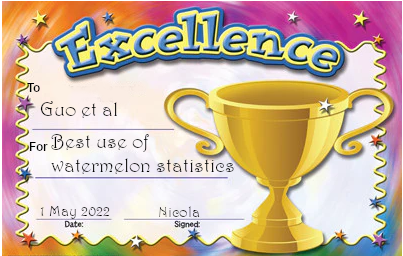
The food packaging ‘Best use of watermelon statistics’ award
It’s serious science, but there is a cartoon watermelon and beetroot in the abstract of this paper(1) from Gansu Agricultural University in China. Yup, these authors were definitely playing my song! Did you know that China is the world’s largest watermelon producer? Or that Beijing alone produces 10,000t of waste watermelon rinds PER DAY? Or the cost of pectin (yes that stuff Nana used to make jam) is getting out of hand for food manufacturers? You do now.
And how does this all fit together? Well it’s simple. This ingenious team used watermelon rind to make pectin and combined that pectin with beetroot extract. Bing, bang, bong. You’ve got yourself a biodegradable, non-toxic disk that sits in with your packaged beef. This clever disc acts as a pH indicator and tells you (through a change in colour) if there has been a breakdown in the cold storage of your chilled beef. A win for food safety and for consumer trust when buying high-end chilled beef. As a plus, your Nana would probably be able to replicate the very well written (and not at all scary) process that they used to make the melon give up its pectin. There were other notable papers on beef packaging. Scientists are putting the pedal to the metal to address consumer concerns about the origin and safety of food packaging. The hunt is on for sustainable “active packaging”- that is packaging that not only contains the meat, but puts in the hard yards controlling or measuring the chemistry of beef.
Honourable mentions: All the research teams making antimicrobial coatings out of, among other things, chitosan (from prawn shells), agar (seaweed) and essential oils.

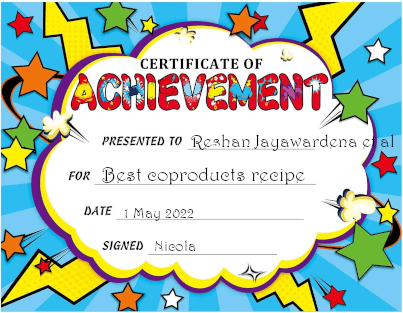
The food science ‘Best coproducts recipe’ award
Want to know how to get the elderly to eat more beef rolls? The best spices to put in your pepper soup beef hides? Wanna make a surimi-like substance out of spleens? The food scientists have got you covered. Our committee thought long and hard about which off-piste beef they would most like to partake in. It was definitely the garlic marinated beef hides (2) from the University of Dschang-Cameroon.
But, ultimately the prize belonged to the team from NZ’s own Lincoln University(3) who are turning beef lungs into protein supplements. Lungs are usually rendered as they are prone to contamination. On top of that, they look creepy as all hell, even to your pet.
Processing them into a powder yields a nutritious, safe protein powder that is rich in iron, copper and magnesium. It has the makings of an affordable health supplement. The authors are able to tell us what it looks and feels like when added to semolina dough, but no word yet if anyone took a bite.

The social science ‘Best use of twitter’ award
Like the rest of us, the data scientists have been poring over social media trying to work out what on earth is going on. Twitter is a popular platform to study, perhaps because it is the wild west of public interactions. Got a half-baked opinion on something? Hold the line while Twitter finds a thousand perfect strangers to tell you how wrong it is. Got a cute picture of your cat, mmm ok, let’s show that to two coworkers and a B-list celebrity.
Twitter is obviously bonkers, but it is nice to have some scientific proof. Our winners dish up a 25 page analysis(4) of twitter interactions following the 2019 IPCC report on land. The Intergovernmental Panel of Climate Change (IPCC) released a very carefully worded report (and their own twitter tweets) about land use. They explicitly stated that they were not there to recommend people’s diets. Perhaps because they anticipated (correctly) how poorly people respond to being told what to eat. They also mentioned that it would be great if people could waste less food and that animal-sourced food is alright by them if produced sustainably. Then they brushed off their hands and considered the job done.
But, my friends, that is NOT how twitter works. Our winners analysed over 27,000 twitter posts that were part of the extensive social media debate that ensued. To make their job a little easier, 76% of these posts were discarded because they were copy-paste retweets or inane posts from parasitic robots.
The remaining posts were analysed for “toxicity” ranging from neutral discourse to out-and-out hate speech. For any farmer who has ventured onto social media, it will be little surprise to hear that the topic of meat-eating was particularly venomous -its toxicity ratings a narrow second place to a discussion about whether or not the IPCC is a scam. But the IPCC didn’t make any recommendations about meat eating? Doesn’t matter. One side of twitter thought the IPCC was telling them to quit meat and was angry about the IPCC pandering to the vegans. The other side knew that IPCC wasn’t trying to have meat banned and they were pissed off about the IPCC pandering to the meat-eaters. Both groups were able to hit the low-tide point on human civility.
The authors helpfully point out that the days of sending out a press-release and considering your science communication “done” are over. You have got to stick around and try to manage the crazy rollercoaster of public debate.
Honorable mentions: The team using the world’s tweets to identify supply chain interruptions. There is also a team that analysed who is winning in the twitter beef between the people tweeting #eatlessmeat and people tweeting #sustainablemeat or #ethicalmeat. Although, you are probably better off not knowing the answer.

The information technology: ‘The sassy award for the spiciest paper’
Our winners start punching early with the title “Garbage in Garbage out: the precarious link between IoT [internet of things] and blockchain in food supply chains”(5). I need to skirt over some definitions. The Internet of things is pretty much what it sounds like- things connected to the internet. You know, sensors and eID readers and the like all talking to the tin men in the sky.
Blockchain is an information system that is kind of like telling everyone in your discussion group to turn to today’s date in their diary and write down that cow 93 died, using an indelible marker. There you go, now everyone has a record of cow 93’s demise and you can’t take that information back without all your neighbours calling you a liar. Of course, that doesn’t make it true. Perhaps you forgot your numbers again and it is actually cow 63 pushing up daisies. Or to use the words of our winners, “data on blockchain may just be … very secure garbage.”
The authors even take jabs at the bedrock beneath the feet of the ag tech bros. The very thesis of all this gibbering excitement is that deploying these information systems enhances trust between supply chain partners. Not so, say the authors, and nor is it necessary. If you trust someone you won’t want to read their diary. If you don’t trust them, how is a wheelbarrow of possibly bogus information going to help? Besides “the key feature of successful economies is that they involve the ability for strangers to engage in commerce”. It’s a zero trust environment where you rely on the authorities to get rid of the bad actors. When I review recent history that rings true. If babies start dropping dead with melamine in their system, then we can rely on the Chinese government to execute someone. If beef patties test positive for horse DNA (nature’s blockchain), then someone is saying hello to a European jail cell. Ignore enough drug withholding periods and you can get your whole country banned from the international markets.
Despite all the rocks being thrown, our winners are not against the use of blockchain. They operate a system called BeefLedger which sounds like a deceased Hollywood actor, but is actually some kind of beefed up blockchain arrangement.
Honourable sassy mentions: just about everyone involved in the long standing wet- vs dry-aged beef debate.

Immunology: “Best use of a RAT” award
Do you remember a time when rapid antigen tests (RAT) were not common vernacular? Once upon a time, you saw a plastic stick with two lines on it and you awkwardly mumbled “congratulations?”. But scientists have been working on introducing RATs, or as they are more commonly referred to as “lateral flow tests”, into the food industry for years. The variety of tests in development gives a pretty good insight into the diversity of the global beef market. Would you like to test your beef for the presence of duck meat, donkey meat, insecticide residues, or a certain bacteria? Would you like to test your cattle feed for animal products? How about the animal itself? Would you like to test for tuberculosis, johne’s disease, leptospirosis, etc? Or circle all the way back to pregnancy tests? It seems like we are on the precipice of a real change in how we diagnose and treat life’s little agricultural upsets. I predict a future where we will no longer look to clairvoyance to treat a sick animal.
So it was hard to pick a winner in this category. But the prize ultimately went to a paper(6) from a group at the University of Shanghai. This team is developing a fluorescent RAT test that detects three different forms of bacterial contamination in beef samples.
Honourable mentions: We are going the Time magazine route and doing an honourable mention to RATs themselves.
That concludes our awards ceremony. We would just like to thank all the scientists putting in the hard yards this past year. The ones investigating the less newsworthy topics of greenhouse gas emissions modelling, growth rate trials, arguing over the genetic correlations of production traits, cooking protocols, beef additives, disease prevalence etc etc. I see you. I respect you. I honour you…just not with awards!
This article was originally published in CountryWide magazine in May.
References
1. Guo Z, Ge X, Li W, Yang L, Han L, Yu Q. Active-intelligent film based on pectin from watermelon peel containing beetroot extract to monitor the freshness of packaged chilled beef. Food Hydrocoll. 2021 Oct 1;119:106751.
2. Maguipa TCL, Mbougueng P, Womeni H. Evaluation of the sensory attributes of pepper soup beef hides and determination of the preservative potential of the spices used for its preparation. J Agric Food Res. 2022 Jun 1;8:100293.
3. Reshan Jayawardena S, Morton JD, Bekhit AE-DA, Bhat ZF, Brennan CS. Effect of drying temperature on nutritional, functional and pasting properties and storage stability of beef lung powder, a prospective protein ingredient for food supplements. LWT. 2022 May 1;161:113315.
4. Sanford M, Painter J, Yasseri T, Lorimer J. Controversy around climate change reports: a case study of Twitter responses to the 2019 IPCC report on land. Clim Change. 2021 Aug 31;167(3):59.
5. Powell W, Foth M, Cao S, Natanelov V. Garbage in garbage out: The precarious link between IoT and blockchain in food supply chains. J Ind Inf Integr. 2022 Jan;25:100261.
6. Liu C, Wu Y, Tian Y, Fang S, Wu M, Liu T, et al. A Lateral Flow Immunoassay Strip with Aggregation-Induced Emission Tcbpe for Multiple Detection of Shigella Boydii, Salmonella Typhimurium, and Escherichia Coli O157:H7. SLAS Technology Volume 26, Issue 4, Pages 377-383
 Nicola Dennis