
[Originally published in CountryWide Magazine]
Have you heard about the EAT-Lancet planetary health diet? The one that says we can only eat roughly a tablespoon of red meat per day? Yeah, I thought you might have.
There is a good chance that a scientific paper called “Food in the Anthropocene: the EAT-Lancet Commission on health diets from a sustainable food system” rings no bells of recognition for you. But, the results of this paper have been discussed far and wide.
“Save the world by eating less than 15g of red meat per day” the headlines screamed. Everyone in the red meat industry took a resolute sigh and steadied themselves for the next round of bashing.
Why are the authors recommending that people cut down on the red meat? Contrary to what you might have been told, it has nothing to do with greenhouse gases or the environmental impact of red meat production. Don’t get me wrong, the authors get around to grandstanding about that later in the paper, but they chose 14g/day of red meat based solely on health benefits of cutting down red meat consumption.
After digging through existing scientific studies, the authors conclude that red meat consumption (e.g. beef, sheepmeat and pork) is weakly correlated with the risk of cardiovascular disease and cancer. The majority of the evidence supporting this conclusion came from studies looking at the diets of middle-aged American people in the 1980’s and then tracking them to see if they died of cardiovascular disease or cancer over the next 20 years. The average age of the participants at the start of the study was 52 years, but some were already well into their seventies. We could argue that cardiovascular disease (i.e. heart disease, stroke, aneurysm etc) and cancer are some pretty widely flung nets. Nearly everyone eventually dies of cardiovascular disease or cancer if they are lucky enough to avoid an unnatural death.
But we know that, like everything, there must be an upper limit to how much red meat you can consume before you are overdoing it. So let’s take a look at what the results of that study.
Well, some of the people in the study were eating 2.4 servings (200g/day) of red meat per day. At the other end of the scale, there were a group of people who were averaging one red meat serving every 4 days or so (21g/day). The 200g/day meat maniacs were 40% more likely to pop their clogs than the people eating 21g/day. That sounds bad, doesn’t it?
But let’s look at that in a different way. Each year, about 1% of the sometimes-meat-eaters died of cardiovascular disease or cancer. And every year, 1.4% of the meat maniacs died of these same diseases. That’s still a 40% increase, but a little bit of perspective helps a lot, doesn’t it? Over the course of the study, perhaps 20% of the sometimes-meat-eaters died of cardiovascular disease or cancer and then perhaps 28% of the meat maniacs went the same way.
Most people would not eat red meat at every meal, but if you do, there are faster and surer ways to bring about death. It is also worth noting that alcohol, tobacco and total energy consumption were also higher in the meat maniacs compared to the cleaner-living sometimes-meat-eaters.
The authors of the EAT-Lancet commission considered this study (which to be fair, included lots of people eating more normal amounts of red meat in the middle of these two extremes). They concluded that:
“Because data on the risk of low intake of red meat are imprecise, we have concluded that an intake of 0 g/day to about 28 g/day of red meat is desirable and have used the midpoint of 14 g/day for the reference diet”
So they set the threshold at 28g/day, which was a little more than the some-times-meat-eaters from above. But then, for reasons known only to themselves, they cut the number in half. It is an ultra-cautious position to take on a small risk of dying in your seventies.
However, the authors plan to cut out two-thirds of the world’s red meat consumption, just to be sure. I am not even exaggerating, the paper provides a handy little graph outlining the change in consumption between current diets and their recommendations. Spare a thought for Sub-Saharan Africa which would be stripped of 85% of their starchy vegetables if the authors had their way.
Doing a back of the envelope calculation (using OECD consumption data), the average New Zealander consumes around 96 grams of red meat per day. Under the EAT-lancet diet recommendations, we would cut out over half a kilogram of red meat out of our diets per week. It sounds unachievable, unappetising and unnecessary. But, there is no doubt that this “science” is getting pushed in front of the nose of a lawmaker or doctor near you.
The paper even suggests ways that governments could legislate this diet. I think good ol’ human apathy will see this dog of a diet put to bed. Why? Did I mention that 100% of those tobacco smoking, overeating, red meat maniacs from before were doctors and other health professionals?
If not meat, then what?
Well not eggs, the authors restrict consumption of eggs down to 13 g/day or about 1 and a half eggs per week for absolutely no rhyme or reason. The authors plan to cut out over 60% of global consumption of eggs and don’t bother to say why.
The same goes for poultry. The average New Zealander would be losing 43g/day of poultry out of their diet. The authors concede that 58 g/day (400g a week) is the higher end of the optimum consumption (although they don’t explain why), but like red meat, they decide to take the midpoint between zero and the higher end and arrive at 29 g/day.
Unable to muster a strong case against the consumption of milk (dairy consumption is favourably associated with bone health and reducing the incidence of diabetes) the authors concede that there might be a wide range of intake amounts possible for milk. Somehow, they come to a range of 0 to 500g/day and then split the difference to arrive at 250 g/day for their reference diet. This doubles the global consumption of dairy. I am confused about what we will do with all the calves from these extra cows if we aren’t allowed to eat them.
The authors laud over fish for its omega-3 fatty acid content and its effects on brain development. I take the time to note here that vitamin A, iron, zinc and numerous other brain healthy things in red meat don’t get this kind of regard. You want to see how smart your kids are going to be when they don’t get enough riboflavin on the recommended diet (the authors suggest you give them some supplements to prevent them from dying which is kind of them).
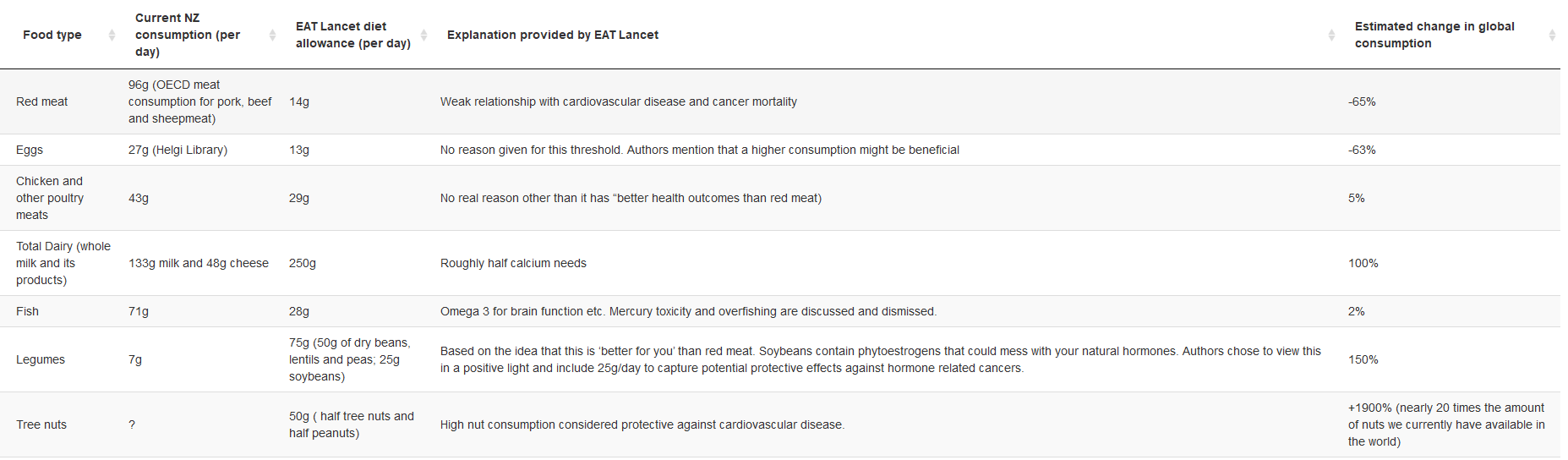
The authors take a couple of paragraphs to skim over the issue of mercury contamination of fish and then dive straight into recommending 28 g/day. What? No splitting the difference? No haggling for fish? Sub-Saharan Africa is going to have to cut back on its current fish consumption, but the rest of us will need to increase our rate of over-fishing.
We are still running at a protein deficit. But not to worry, you can eat 50g/day of nuts (including peanuts). Just how everyone will source 350g of nuts per week is a bit of a mystery. Global consumption of nuts is less than 10% of what the authors are recommending. North America has the highest consumption at a mere 20% of the recommended diet. I don’t think a keen environmentalist would advocate that the US needs to increase its almond production.
Anyway, they are going to need that land to quadruple their production of legumes. We’ll be needing 50g/d (dry weight) of a mixture of beans, lentils and peas.
Soybeans contain phytoestrogens which can interfere with your natural hormones. Apparently, the authors think this is a good thing as it “could” reduce the risk of hormonally related cancers. I expect there could be some adverse side-effects. Anyway, we will have a better idea once they have the whole world eating 25g/day of the stuff.
Science papers are reviewed by independent scientists (peer-reviewed) before they can be published. One of the reviewers seems to have questioned whether the authors have considered alternative proteins because the authors take a brief detour to discount adding insects, cyanobacterium and lab meats in their diet.
You can, however, use 50 g/day of fat to cook your food in this diet. Yep, you can cook your 100g total of meat for the day in 50g of fat. Move over Jamie Oliver, there’s a new chef in the house.
“Because sugar has no nutritional value and [has] adverse metabolic effects, we use a limit of 31 g/person per day…”
Stop the truck! We can have double the amount of sugar compared to red meat, just cause? Methinks it is because sugar is derived from a plant and not an animal, but perhaps I am cynical.
 Nicola Dennis
2 thoughts on “That damn EAT-Lancet report”