
[Originally published in CountryWide Magazine]
I was listening to the new Mercado podcast yesterday and the team was talking about the pressures faced by farming to maintain its “social license”. If you stop and think, we could argue about the social license of every product we use. Coffee is not a necessary food group and yet we are “ok-ish” with poorer countries being exploited to have a cup of java. We don’t need to get on a plane and burn a tonne of fossil fuels, but we want to get to the heat and take some photos that we will never look at. To be fair to Mercado, I want to be clear that we have now descended into my interpretation of the world.
So why do we give our food producers an unfair suck of the social license sav? Everyone needs to eat, right?
Yes, they do, and I think that is part of the problem. Everyone needs to eat and therefore there is BIG money in food and in food marketing and in becoming a self-proclaimed nutritionist on social media.
There are also decent incentives for researchers who might like to slightly exaggerate a problem in order to access funding or get a paper published. I’m not suggesting that scientists accept bribes, but that in order to get money to do important research or get any sort of attention at all, scientists often have to present their research in a way that makes it sound like they are about to save the whole damn world.
Next month, I am going to be taking a deep dive into a scientific paper that makes some pretty big claims about a ‘planetary health diet’. Yep, it’s that damn Lancet EAT commission paper that is claiming we need to limit our diets to 14 grams of red meat per day. The diet is bonkers, but right now, I want to focus on one very tiny, but important part of this paper. The bit where it says the world population is going to grow to 10 billion people by 2050 and this means that we must act now to plan how to feed the world.
This is the catch cry of many other groups too. Those that want to implement ‘vertical farming’ or ‘lab-based meats’ or farm insects. But, is it true? When I stopped to think about it, I don’t know many families that have more than two kids. In fact, I know plenty childless couples and families (including our own) that only have one child (those who want to filibuster me on the virtues of having a second kid will have to wait in line behind the angry scientists from earlier in the article).
You are all smart people so I won’t waste too much time explaining that, on average, a couple needs to have 2 children to keep the population stable. Actually, experts say the total fertility rate (average number of births per woman) needs to be 2.1 because not everyone has the privilege of living long enough to be able to breed.
The total fertility rate for New Zealand in the latest data (2016) is 1.87. This suggests that our population would not grow without immigration. And NZ is not alone, the total fertility rate in pretty much every country in the developed world is below the replacement rate. Refer to this figure made by yours truly using world bank data. When we look at all the countries of the world (barring some really little ones which I excluded), we can see that nearly every country with a high total fertility rate has a low GDP per capita. Those countries that are growing are almost exclusively countries that already cannot afford to feed all their people.
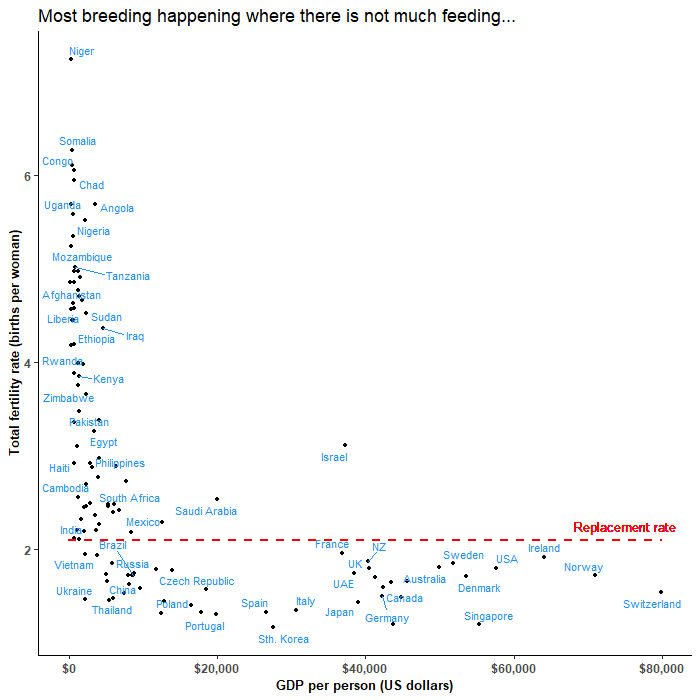
Currently, there are an estimated 820 million people worldwide who don’t get enough to eat. The sad reality is that we cannot save these people by changing western world farming practices because the issue isn’t food, its politics and (just when you thought I had finished angering people) it is women’s rights. I am not convinced that the 10-year-olds being married off to polygamous relationships in Niger would choose to have 7 kids each if they had viable alternatives. Are the ladies of Somalia, where women are often subjected to mutilation, actually ok with mothering 6 kids? Alrighty then, I’ll show myself to the door now…
 Nicola Dennis